
Teak Is Not One Grade: Why Low-Priced "Teak" Furniture Fails Early, and How to Judge Real Value
· WisutWood, full-cycle solid wood factory in Surat Thani · Wood knowledge and ordering

In short: the word "teak" says nothing about grade. Most teak on the market is young plantation teak, and most of its timber is still sapwood — Thai research does not recommend it for load-bearing furniture such as beds or tables. The price gap usually hides in 3 places: the timber · kiln drying · how the joints are made. For a business, compare cost per year, not price per piece — send us a site photo and let our craftsmen take a look
Key facts
- Teak grown for 10 years has around 36% sapwood · 25-year-old timber around 18% (Journal of Tropical Forest Science 2014)
- Kiln-dried 12-year-old teak thinnings reach a bending strength (MOR) of around 79 MPa against around 65 MPa undried — around 23% more (IJDNE 2023)
- Benchmark for everyday furniture > 500 kilograms-force · a traditionally mortised chair withstood 1,472 kilograms-force (ISO 7173)
- The real cost of furniture = price ÷ years in service → invest once, use it for years
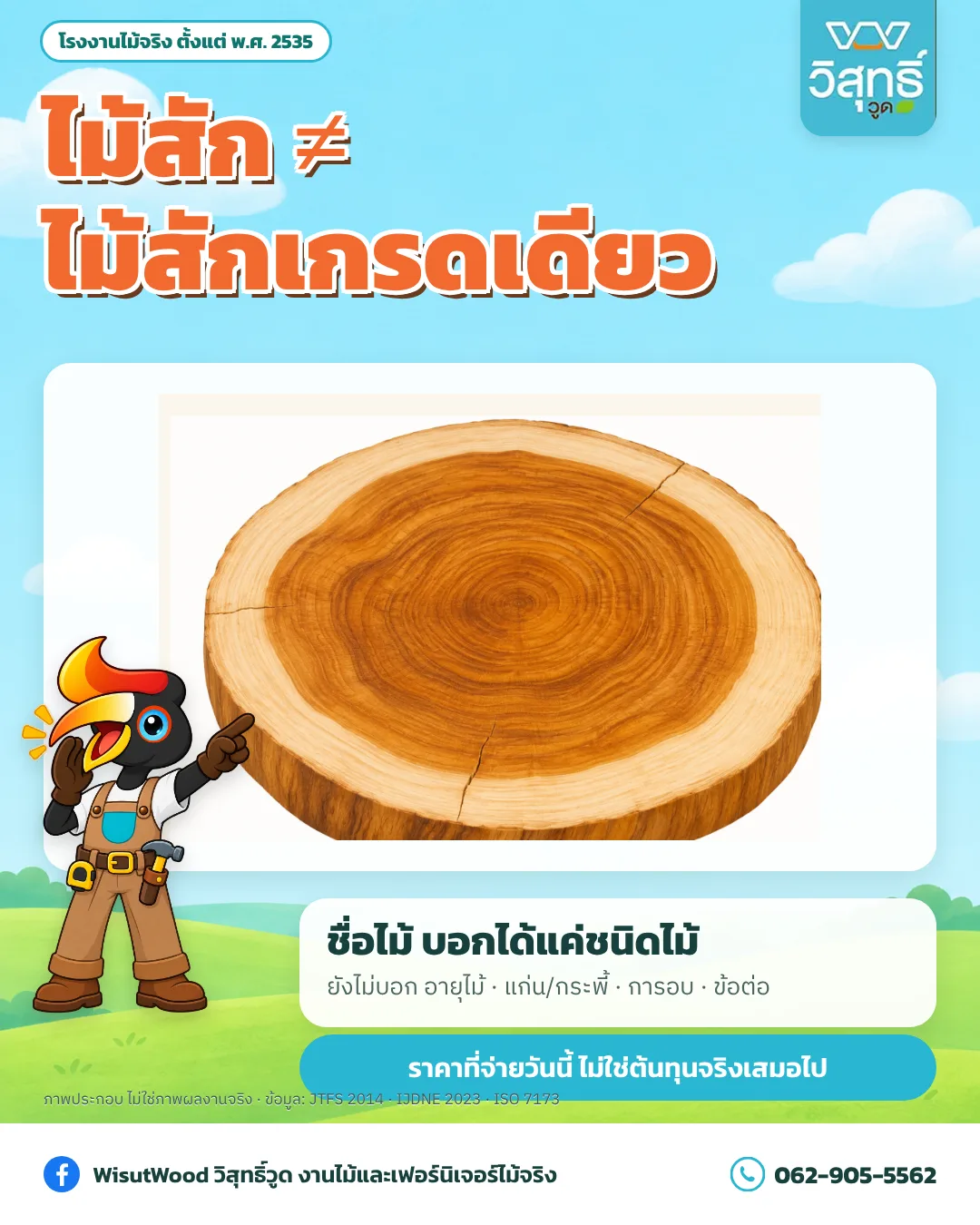
How many grades of teak are there, and what is the difference?
Thai buyers trust teak, so the name is often used as a selling point. In reality teak varies a great deal with the age of the tree and which part of the log the timber comes from.
- Heartwood — the golden-brown inner wood, with natural oils; strong and resistant to borers and termites. This is what gave teak its reputation.
- Sapwood — the pale outer wood; softer, and far easier for borers and termites to attack. Young trees have a lot of it.
| Type of teak | Timber character (from research) |
|---|---|
| Young teak, 7–14 years / thinnings | Mostly sapwood, soft, many knots, pale, warps easily · not recommended for beds, dining tables or wardrobes |
| Smallholder plantation teak, ~15 years | Little heartwood, mostly sapwood, high risk of warping and bowing unless kiln dried first |
| Forest plantation teak, ~30 years | Large heartwood core, dark brown, few defects |
| Reclaimed teak (from old houses) | Very stable, shrinks and swells very little, but very hard to find |
Even sawn teak from Thai state agencies is graded: grades B–D are timber with knots, attached sapwood or borer marks, which goes into work that carries little load. And in 2024 (B.E. 2567) most of the sawn teak produced came from plantations — more than a hundred times the volume from outside plantations. So the "teak" you usually see is plantation teak, and the next questions are how old it is and how much of it is heartwood.
Why do teak furniture prices differ? 3 things you cannot see at purchase
1. The timber — heartwood or sapwood The price of teak timber can differ several times over between young plantation teak and good-grade heartwood. If a piece is priced far below the market, the difference usually comes from here.
2. Kiln drying Timber that is not dried, or not dried enough, shrinks, splits and warps, and loosens the joints later. Dry timber also takes around 1.4–1.5 times more bending load than green timber. WisutWood kiln dries timber in our own factory before it goes into production, every time.
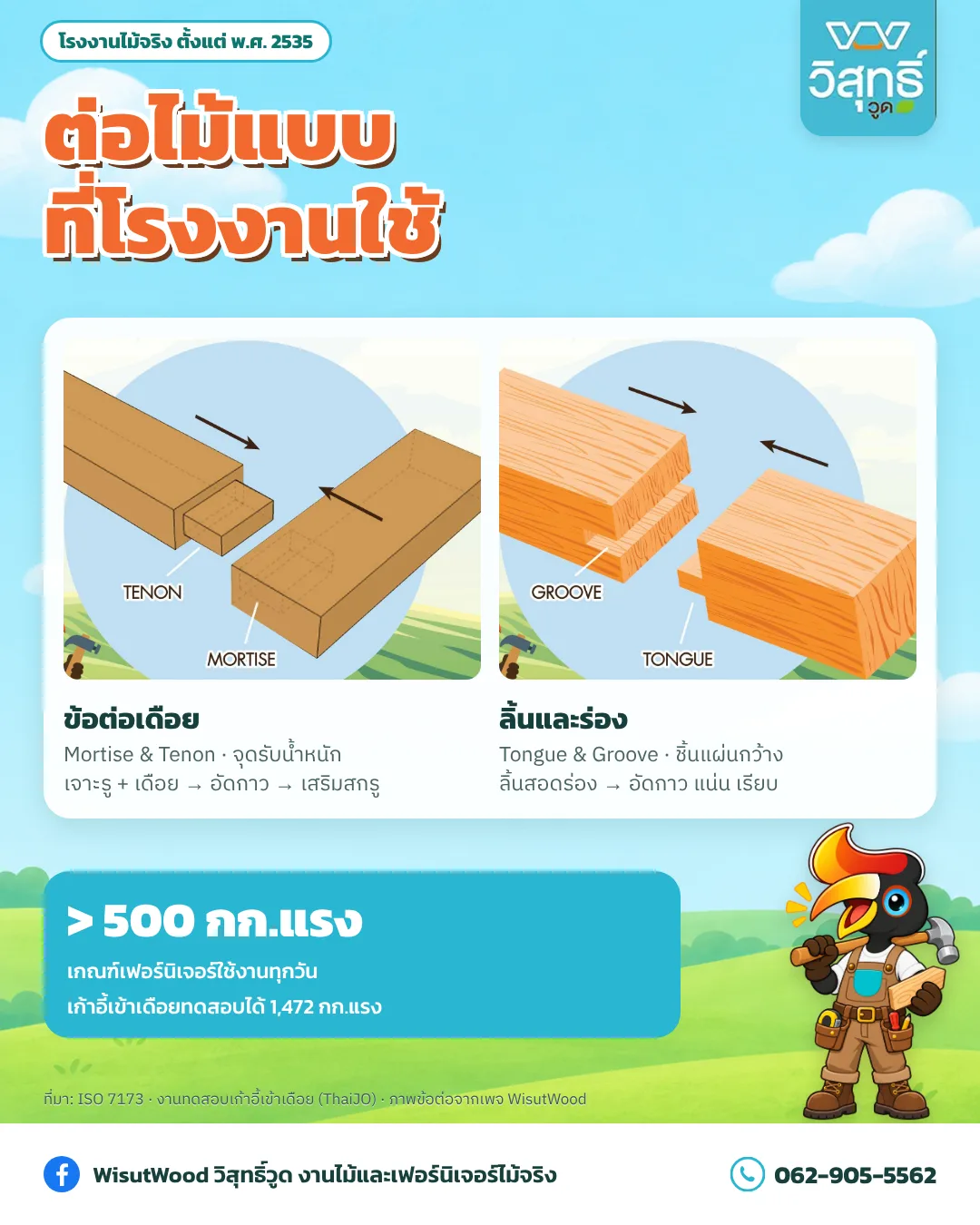
3. How the joints are made — mortise and tenon with glue, or nails alone At load points such as bed legs, chair legs and seat rails, joints held only by nails or staples start to wobble before long. Chair testing to ISO standards indicates that everyday furniture should withstand more than 500 kilograms-force, and properly made mortise-and-tenon chairs withstand far more than that. At WisutWood every load point is mortised, tenoned and glued.
The engineering figures: not beliefs passed down by word of mouth
The figures below come from research and wood databases you can check (see the references at the end) · MOR = modulus of rupture, the maximum bending stress before the wood breaks (higher carries more load) · MOE = modulus of elasticity, stiffness against sagging · MC = moisture content of the wood at the time of testing
1) Teak age → share of sapwood (teak plantations, Luang Prabang, Laos)
| Age | Heartwood (%) | Sapwood (%) | Density at 12% MC (kg/m³) |
|---|---|---|---|
| 10 years | 64 | 36 | 714 |
| 15 years | 75 | 25 | 697 |
| 20 years | 77 | 23 | 709 |
| 25 years | 82 | 18 | 664 |
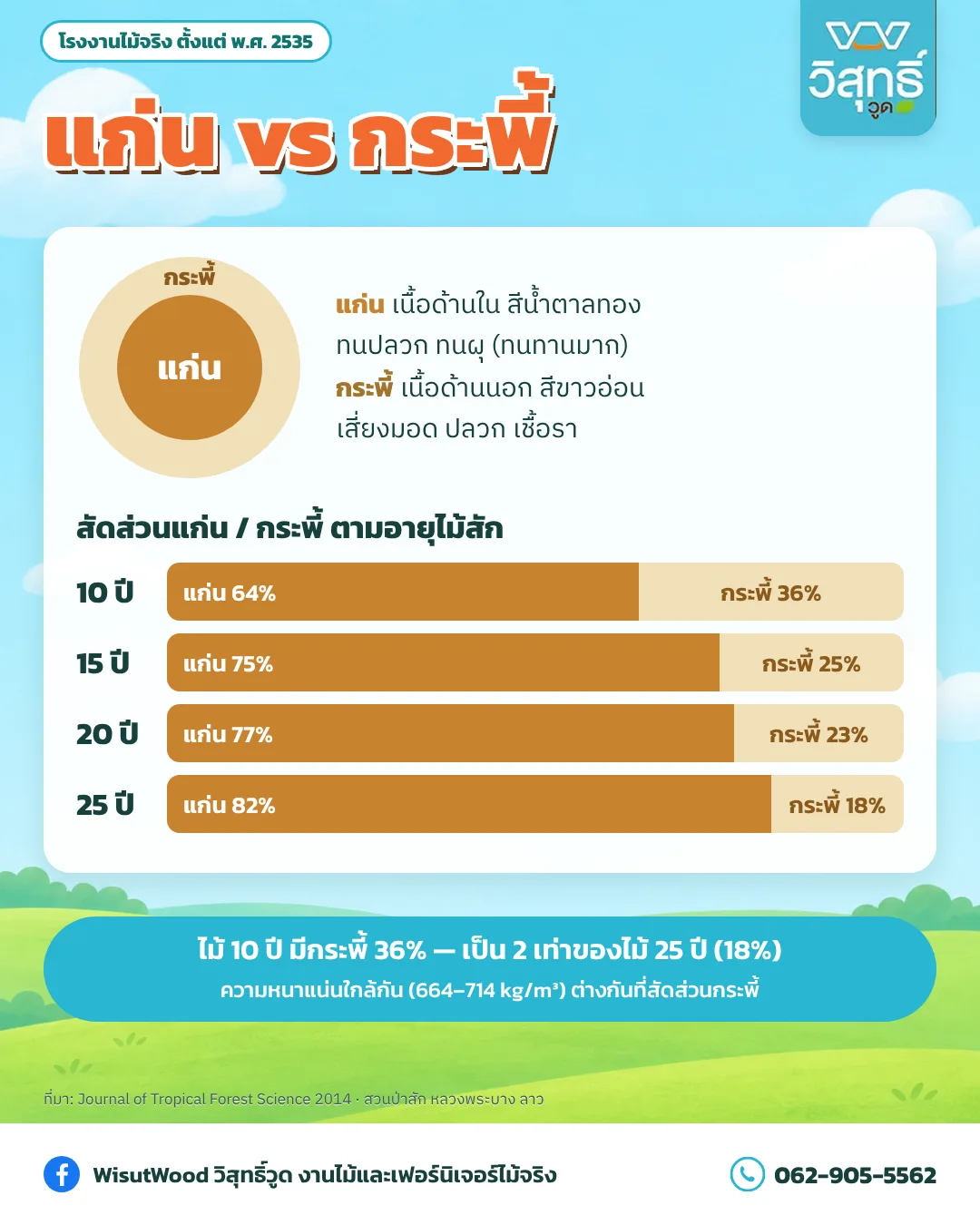
Young teak is about as dense as older teak, but 10-year-old timber has twice the sapwood of 25-year-old timber — and teak's resistance to termites and decay lives in the heartwood, not the sapwood. Furniture made from timber with a lot of sapwood is therefore at higher risk of borers, termites and fungi, even though it is still called teak.
2) Kiln drying → bending strength (12-year-old teak thinnings, Lampang, compared with the Royal Forest Department reference value for teak)
| Timber | MOR (MPa) | MOE (GPa) |
|---|---|---|
| 12-year teak thinnings · not kiln dried (MC 13.5%) | ≈ 65 | ≈ 8.1 |
| 12-year teak thinnings · kiln dried (MC 9.3%) | ≈ 79 | ≈ 9.2 |
| Teak reference value, Royal Forest Department (MC 12%) | 100 | 10.2 |
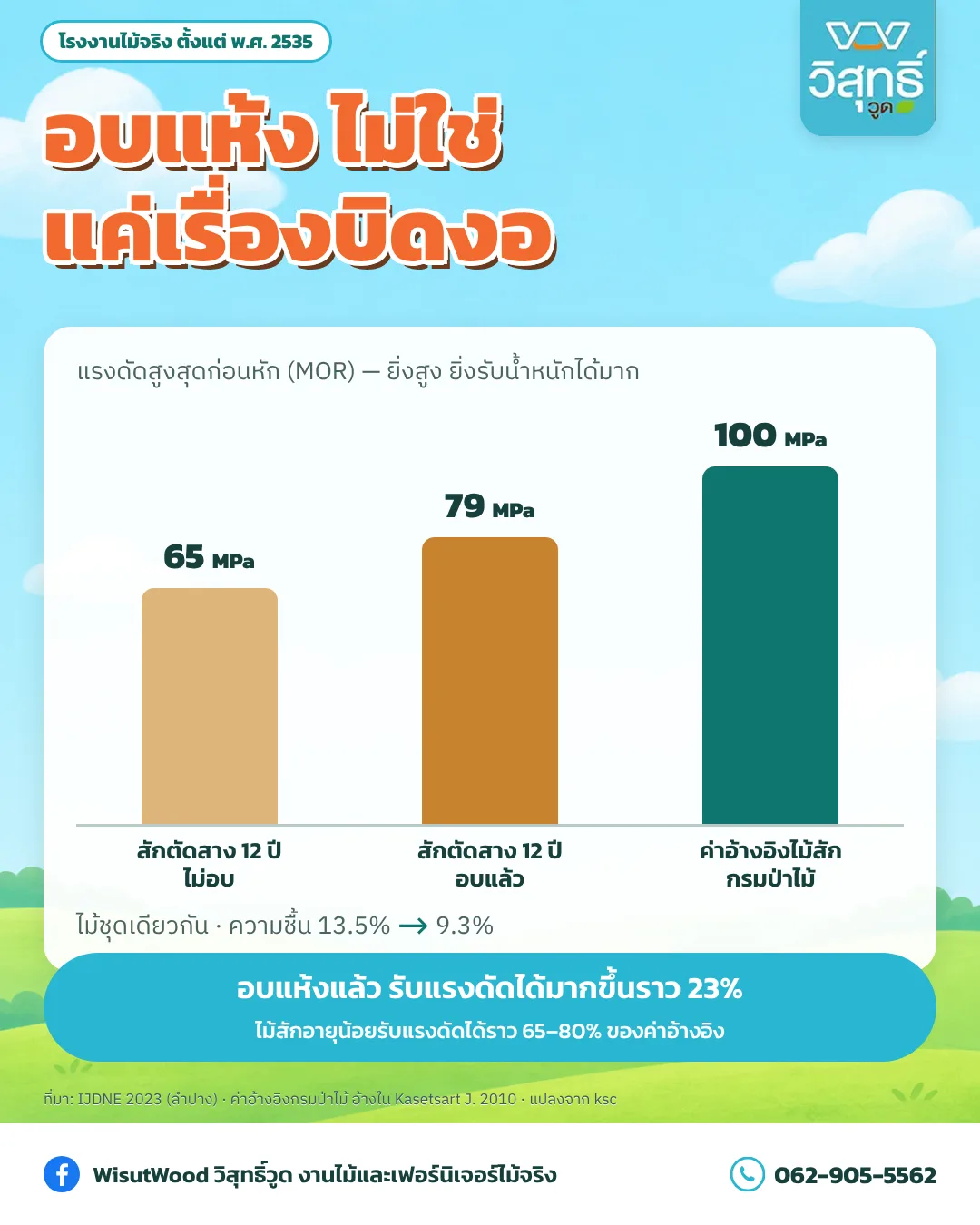
The same batch of timber takes around 23% more bending load once kiln dried, and young teak still reaches only around 65–80% of the teak reference value (figures from different studies, whose test methods may differ — read them as a trend · converted from ksc: 1 ksc ≈ 0.098 MPa)
3) Woods used for furniture compared (reference values at MC ~12–15%, the same set as our wood guide)
| Wood | Density (kg/m³) | MOR (MPa) | MOE (GPa) | Natural durability |
|---|---|---|---|---|
| Teak heartwood | 655 | 97 | 12.3 | Very durable, termite resistant |
| Takhian Thong (trade-group value) | ≈ 735 | ≈ 105 | ≈ 13.5 | Moderate · sapwood at risk from termites |
| Sadao Thiam (research) | ≈ 650 | ≈ 76 | ≈ 7.1 | Low–moderate · interior work |
| Rubberwood | 595 | 72 | 9.1 | Not resistant to decay/insects; needs pressure treatment |
| Radiata pine | 515 | 79 | 10.1 | Not resistant to decay |
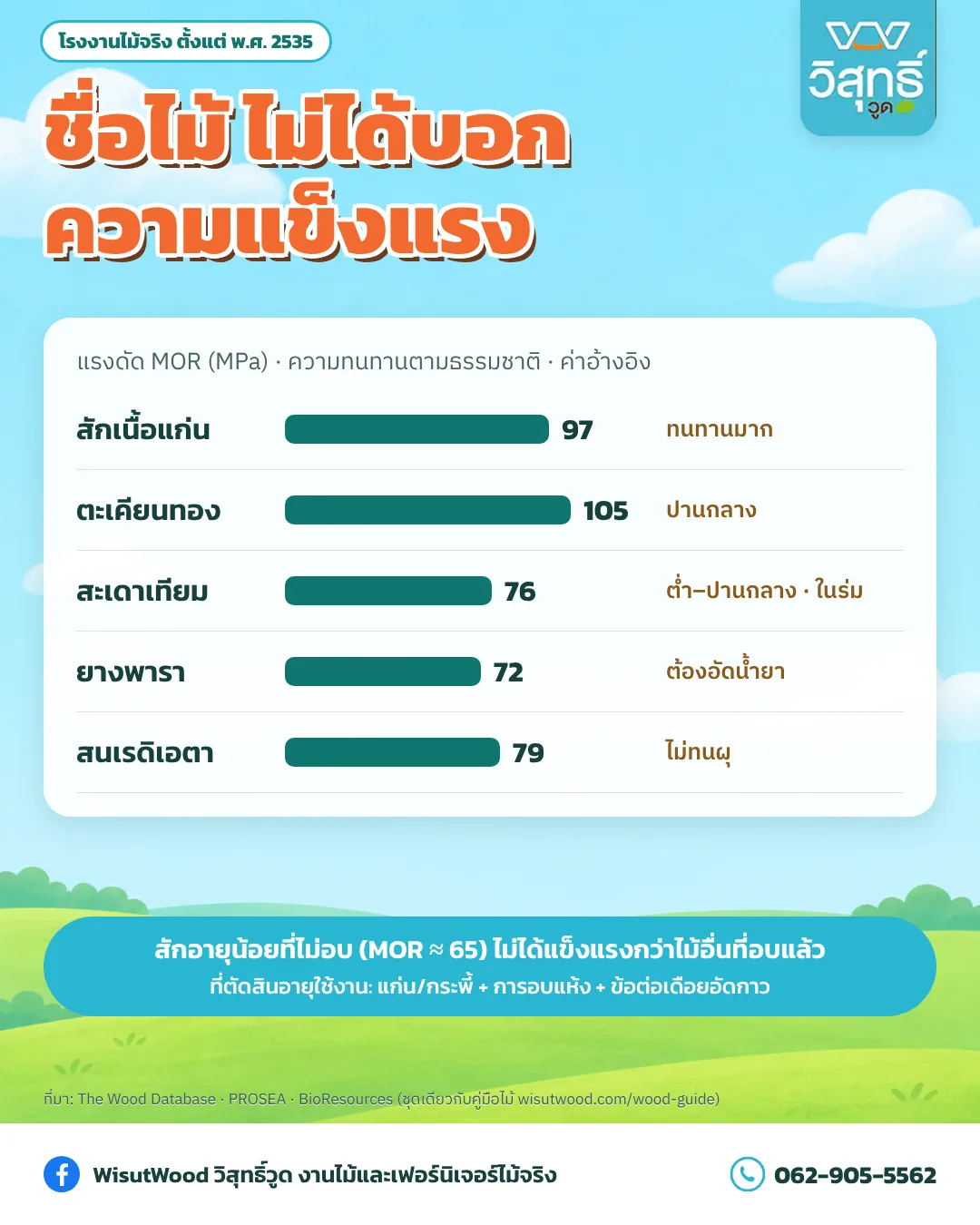
The table makes one thing clear: the name of the wood does not tell you its strength. Young teak that has not been kiln dried (MOR ≈ 65) does not take more bending load than kiln-dried Sadao Thiam or rubberwood. What decides real service life is heartwood or sapwood + kiln drying + glued mortise-and-tenon joints, and choosing the wood to match where it will be used (indoors / semi-outdoor / by the sea).
How the factory joins timber: the load should go into the wood, not the nails
Joints take the load every time someone sits, lies down or moves a piece of furniture. WisutWood chooses the joint by what each point has to do:
- Mortise and tenon — for load points such as bed legs to the bed frame, or chair legs to the seat rails. The mortise is cut to fit the tenon, glued, and only then reinforced with screws, so the load spreads through the wood across the whole face of the tenon instead of gathering at a few nails or screws.
- Tongue and groove — for wide panels. A tongue and a groove are cut to slot together and are glued, so the boards hold tight, the surface stays flush, and they do not easily pull apart.
Chair testing to ISO 7173 cites a benchmark that everyday furniture should withstand more than 500 kilograms-force, and a traditionally mortised chair withstood 1,472 kilograms-force before failing. See illustrations of both joints on our page: mortise and tenon · tongue and groove
Why this matters more for a business than for a home
For a hotel, resort, dormitory or café, furniture is not a personal possession — it is part of the guest experience. When furniture wobbles or breaks, the business loses more than the cost of the item:
- Reputation and reviews — a wobbly chair or a broken bed reaches the reviews before the owner hears about it
- Safety — furniture that fails in use can injure a guest or tenant
- Revenue — rooms or areas have to close while waiting for repair or replacement
- Money and time — buying again, waiting for production, shipping and setting up all over again
Work out value as "cost per year"
How many years teak furniture lasts depends on heartwood or sapwood, kiln drying and the joints far more than on the name of the wood — so a business should compare furniture cost per year.
Real cost per year = (purchase price + delivery + repairs + revenue lost while rooms are closed) ÷ the number of years it actually lasts
A hypothetical example: set A takes a budget of 100 units and lasts 2 years = 50 units per year · set B takes 150 units (50% more) and lasts 8 years ≈ 19 units per year → over the long run set B costs almost 3 times less, before counting the lost reviews.
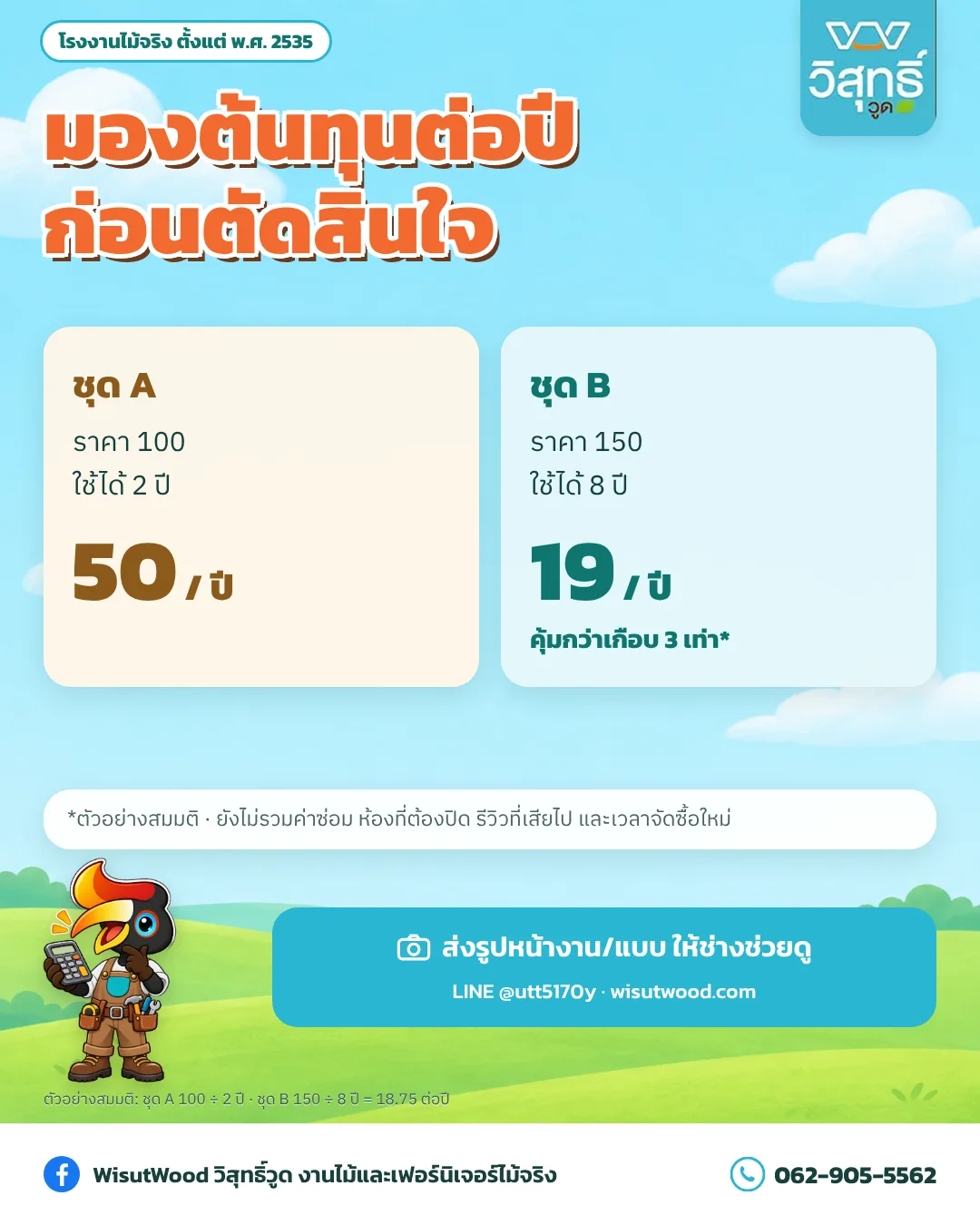
Paying a little more today for timber and assembly made to standard is a better investment than paying again every two years.
Choose the wood for the spot: indoors · semi-outdoor · by the sea
The best wood is the one that fits the point of use and the budget, not the name that sounds most expensive. For example, Sadao Thiam is a real solid hardwood for indoor work on a controlled budget · Takhian Thong for heavy use and semi-outdoor areas · teak heartwood when maximum durability is the brief — see the full comparison in Takhian Thong vs Sadao Thiam vs Teak
| Where it is used | What it faces | Choice of wood | Worth checking |
|---|---|---|---|
| Indoors · air-conditioned (guest rooms, dining rooms) | Humidity swings with the air-conditioning | Kiln-dried timber such as Sadao Thiam, teak or finger-jointed rubberwood, to suit the budget and design | Moisture content before production · joints at load points |
| Semi-outdoor (balconies, open lobbies) | Indirect sun, driving rain | Takhian Thong, teak heartwood, or pressure-treated and coated Sadao Thiam | UV-protective coating · re-coating cycle |
| Outdoors · poolside · by the sea | Direct sun, rain, salt air | Heartwood such as Takhian Thong or teak heartwood · avoid timber with sapwood | Stainless hardware · drainage · re-coating cycle |
Matching the wood to the spot means you do not overspend on indoor pieces, and you do not have to replace outdoor pieces too soon · read more: which wood for poolside furniture
A 7-point checklist before ordering teak furniture for a hotel, resort or restaurant
- Ask to see a cross-section or the edge of the timber — a lot of pale white is sapwood, which does not resist termites or decay
- Ask about the age and origin of the timber — how old the plantation teak is, and how much of it is heartwood
- Ask whether it has been kiln dried, and whether they can show you a moisture reading
- Look at the joints at load points — glued mortise and tenon, or only nails/staples
- Sit on and rock a real sample piece before ordering for the whole project
- For outdoor or seaside work — ask about the coating, the hardware and the care cycle
- Work out cost per year, not price per piece — including repairs, rooms that have to close and the time spent buying again
Why resort and hotel owners in southern Thailand send their drawings to WisutWood
WisutWood (วิสุทธิ์ วูด) is a solid wood furniture and woodwork factory in Surat Thani, open since 1992 (B.E. 2535). We make everything ourselves — selecting, sawing, kiln drying, assembling and finishing — for hotels, resorts, villas, restaurants and cafés across southern Thailand and the islands, with work for more than 1,000 customers.
- Every step controlled in one factory — the spec you agree is the spec you get (see the factory)
- Made in sets to one spec — suited to many rooms, many tables, a whole project
- Wood chosen for the point of use — no overspending, and no replacing too soon
- We think about value on your behalf — we do not aim for the lowest price; we aim for you never having to buy again
See work by business type: resorts · hotels · cafés · portfolio · areas we serve: Surat Thani · Koh Samui · Krabi · Phuket
Bottom line: invest once, use it for years
Since the WisutWood factory opened in 1992 (B.E. 2535), we have heard the same story again and again from owners of guesthouses, dormitories and restaurants: they bought furniture with a low upfront price, then had to repair or replace it within a few years. Low or high price is therefore not measured by the figure on the quotation, but by value for the investment — service life, reputation, reviews, capital and time.
We select the timber, kiln dry it ourselves, and mortise and glue every load point — not to push the price up, but so that our customers invest once and use it for years. Send us a site photo or the drawings you have and our craftsmen will take a look, whether or not you order with us, or get a preliminary estimate.

Frequently asked questions
How many grades of teak are there? There is no single grade. Teak varies with age and with the part of the log. Young teak has a lot of sapwood and is soft, while older teak has more heartwood and is stronger and more durable. Sawn teak is also graded by knots, sapwood and borer marks.
Why is teak furniture so low-priced at some shops? Mostly because the timber is young plantation teak with a lot of sapwood, it has not been kiln dried, and it is assembled with nails or staples instead of glued mortise-and-tenon joints — all of which are hard to see from the outside when you buy.
Can young teak be used for a bed? Thai research does not recommend young teak for furniture that carries load, such as beds, dining tables or wardrobes, because it has a lot of sapwood and the timber can carry only limited weight.
Is Sadao Thiam more expensive than teak? It depends on the grade of teak you compare it with. Sadao Thiam may cost more than young plantation teak, but several times less than good-grade teak heartwood. What is worth comparing is the strength you get for the point of use, not the name of the wood.
How strong is young teak — are there figures? Research on 12-year-old teak thinnings found a bending strength (MOR) of around 65 MPa when not kiln dried and around 79 MPa when kiln dried, against the Royal Forest Department reference value for teak of 100 MPa; and teak grown for 10 years has around 36% sapwood, compared with 18% in 25-year-old timber.
Which grade of teak is best for hotel or resort furniture? Timber that is mostly heartwood, kiln dried, and glued with mortise-and-tenon joints at the load points suits furniture used every day best. Young plantation teak with a lot of sapwood is better kept for pieces that carry no load and stay indoors.
Which wood should be used for seaside or poolside furniture? Use heartwood that stands up to sun, rain and salt air, such as Takhian Thong or teak heartwood, together with a UV-protective coating, stainless hardware and a clear re-coating cycle — and avoid timber with sapwood.
Where does WisutWood make solid wood furniture for businesses? WisutWood is a solid wood factory in Surat Thani, open since 1992 (B.E. 2535), making furniture for hotels, resorts, villas, restaurants and cafés across southern Thailand and the islands. Send us a site photo or drawings and our craftsmen will take a look, whether or not you order with us.
How should a hotel or dormitory compare furniture prices? Compare cost per year, including delivery, repairs and revenue lost while rooms are closed. A set with a higher upfront price that lasts several times longer usually works out better value, without the risk of bad reviews.
References
- Research on young teak and its use in furniture — academic journal (ThaiJO)
- Comparison of teak by origin and testing of mortise-and-tenon chairs — academic journal (ThaiJO)
- FIO grades sawn teak B–D — Matichon
- Timber production statistics 2024 — Royal Forest Department
- Properties of wood (moisture, dry-timber strength) — TruePlookpanya
- Heartwood/sapwood share and density of 10–25-year-old teak — Journal of Tropical Forest Science 2014
- Properties of 12-year-old teak thinnings (undried/kiln dried) — IJDNE 2023
- Royal Forest Department reference values for teak — Kasetsart Journal 2010
- Teak heartwood, rubberwood and radiata pine values — The Wood Database
- The factory's joinery techniques — WisutWood page